Greenhouse Effect and Greenhouse Gases (GHGs)
Incident solar energy as short-wave radiations, mostly in the form of visible light, is absorbed by the Earth’s surface and reflected/emitted back into space as long-wave infrared (heat) radiations. Several gases in the Earth’s atmosphere are transparent to the incoming short-wave radiations but are nearly opaque to the reflected long-wave radiations. Thus, much of the Earth’s heat is retained, which causes a warming effect. This phenomenon is known as the “greenhouse effect (GHE)”, and the gases that have the ability to absorb reflected long-wave radiations and produce this effect are called the “greenhouse gases (GHGs)”.
The most common naturally occurring GHGs (in order of their atmospheric concentration) are water vapor (H2O), carbon dioxide (CO2), methane (CH4), and nitrous oxide (N2O). It is due to the natural occurrence of the greenhouse effect that there is a higher atmosphere equilibrium temperature; otherwise, in its absence, the Earth’s mean surface temperature would have been much lower (as cold as about minus 18°C), making it inhabitable. The natural GHE keeps the planet about 30°C warmer, which is essential for life to exist on Earth.
Enhanced Greenhouse Effect
Since the Industrial Revolution (mid-18th century onwards), there has been a strengthening of the natural GHE through increasing concentrations of natural gases (except water vapors) and additional concentrations of synthetic GHGs due to anthropogenic (human-induced/industrial) activities, resulting in the general warming of the Earth’s atmosphere. This strengthened greenhouse effect, due to anthropogenic activities, is known as the “enhanced greenhouse effect (EGHE)” resulting in global warming and climatic changes of irreversible and highly destructive types.
The most common synthetic (industrial) GHGs are hydrofluorocarbons (HFCs), perfluorocarbons (PFCs), chlorofluorocarbons (CFCs), sulfur hexafluoride (SF6), and nitrogen trifluoride (NF3).
Ozone (O3) is also a strong GHG. The increase of tropospheric ozone contributes to global warming, while the depletion of stratospheric ozone has a cooling effect. However, stratospheric depletion allows more harmful UV radiation to reach the Earth’s surface, which increases the risk of skin cancer and cataracts and can damage ecosystems, among other negative effects.
According to the Intergovernmental Panel on Climate Change (IPCC), human-induced warming has already reached 1°C above pre-industrial (1850-1900) levels. If the current warming rate continues, the world is projected to reach 1.5°C of human-induced global warming around 2040.
Greenhouse Gas (GHG) Emissions
The Greenhouse Gas Protocol (GHGP) is a comprehensive global standardized framework for accurately measuring and managing GHG emissions. The Protocol focuses on the accounting for and reporting of seven GHGs that are currently covered by the United Nations Framework Convention on Climate Change (UNFCCC) and the Kyoto Protocol.
These gases include carbon dioxide (CO2), methane (CH4), nitrous oxide (N2O), hydrofluorocarbons (HFCs), perfluorocarbons (PFCs), sulfur hexafluoride (SF6), and nitrogen trifluoride (NF3). The emissions from GHGs not covered by the Kyoto Protocol (such as CFCs, NOX) may be reported but separately from scopes.
GHG emissions are often reported in terms of “carbon dioxide equivalent” (CO2e). This standard measurement effectively captures the total warming impact of various GHGs, taking into account their distinct global warming potentials (GWPs).
Classification of GHG Emissions
Within the operational boundary of a company, the identified GHG emissions associated with its operations are categorized as Direct and Indirect emissions. Direct GHG emissions are emissions from sources that are owned or controlled by the company. Whereas, Indirect GHG emissions are emissions that are a consequence of the activities of the company but occur at sources owned or controlled by another company.
To clarify the distinction between direct and indirect emission sources, enhance transparency, and serve the needs of various organizations and climate policies and business goals, the GHGP has defined three scopes for GHG accounting and reporting purposes – namely, Scope 1, Scope 2, and Scope 3 emissions.
As per GHGP, it is mandatory for the companies to separately account for and report on Scope 1 and 2 at a minimum. However, the reporting of Scope 3 emissions is optional. Moreover, the companies may further subdivide GHG emissions data within scopes to enhance transparency and facilitate comparability over time. The sources/activities of GHG emissions under different Scopes, as per GHGP, have been summarized hereunder.
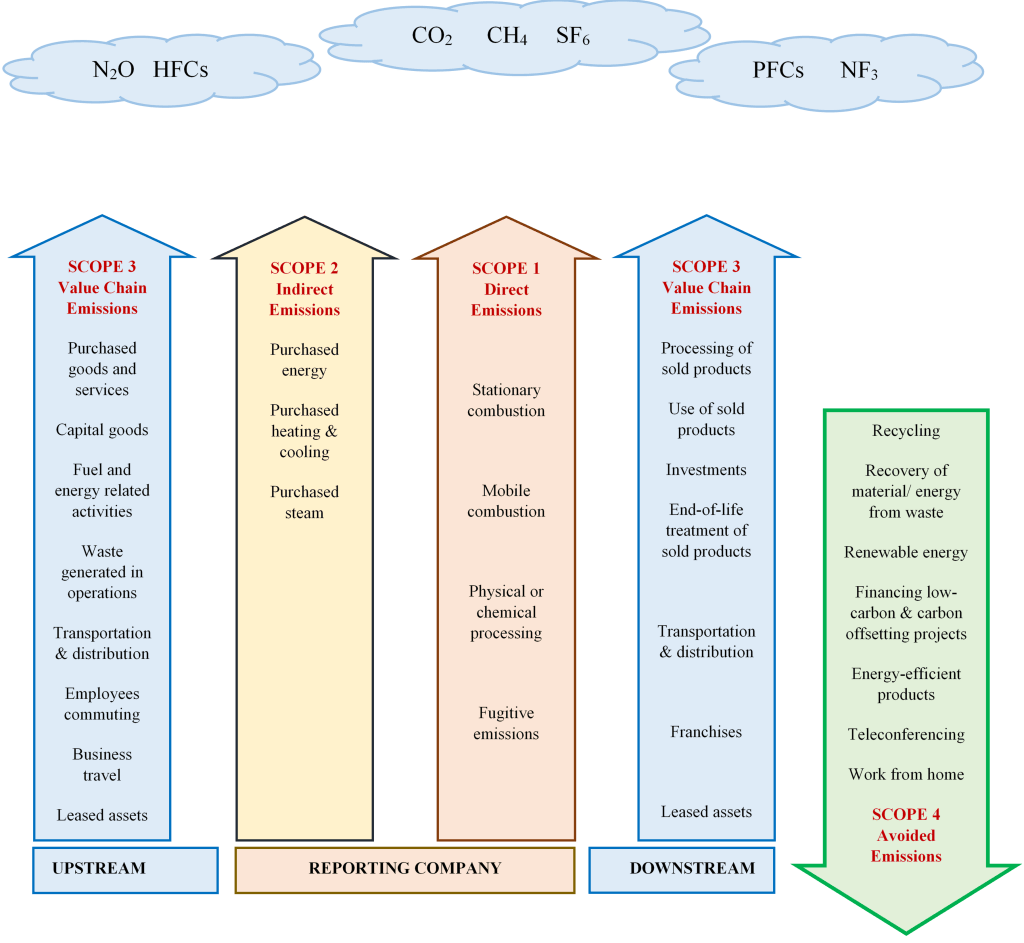
Scope 1: Direct GHG Emissions
As per GHGP, Scope 1 accounts for direct GHG emissions from sources or process equipment that are owned or controlled by the company. These are principally a result of the following activities undertaken by the company –
- Stationary combustion of fuels for generation of electricity, heat or steam: It includes emissions from the combustion of fuels in stationary sources/equipment, such as boilers, furnaces, burners, turbines, heaters, incinerators, engines, flares, etc.;
- Physical or chemical processing: It includes emissions from chemical production or material processing, such as emissions during cement manufacturing, aluminum smelting, ammonia manufacturing, petrochemical processing, and waste processing, etc.;
- Mobile combustion of fuels for transportation of materials, products, waste, and employees: It includes emissions from the combustion of fuels in company-owned/controlled mobile sources (vehicles), such as automobiles, cars, buses, trucks, lorries, trains, airplanes, boats, ships, barges, vessels, etc.; and
- Fugitive emissions: These emissions include intentional or unintentional releases, such as leakages from equipment, HFC emissions from refrigeration and air conditioning, methane leakages from gas transport, emissions from wastewater treatment, methane emissions from coal mines and venting, etc.
Direct CO2 emissions from biomass combustion need to be reported separately and not included in Scope 1.
Scope 2: Electricity Indirect GHG Emissions
Scope 2 emissions are a special category of indirect emissions. It accounts for GHG emissions from the generation of purchased electricity that is consumed by the company in its owned or controlled equipment or operations. Purchased electricity is defined as electricity that is purchased or otherwise brought into the organizational boundary of the company. It is to be noted that Scope 2 emissions physically occur at the facility where electricity is generated.
Scope 3: Other Indirect GHG Emissions
Scope 3 emissions are a consequence of the activities of the company but occur from sources not owned or controlled by the company. These GHG emissions are also called “value chain emissions” or “supplemental emissions” as they result from a company’s value chain. For example, GHG emissions from extraction and production of purchased materials and fuels, transportation-related activities, electricity-related activities not included in Scope 2, leased assets and outsourced activities, use of sold products and services, and waste disposal. There are fifteen indicative activities/categories (under upstream and downstream GHG generating categories) that have been included under Scope 3 GHG emissions.
Scope 3 emissions typically account for 70% to 80% of a company’s total emissions. Although reporting of Scope 3 is strongly encouraged, it is not required, and companies have discretion over which categories of Scope 3 they choose to report.
Scope 4: Avoided Emissions
Scope 4 covers ‘emissions avoided’ when a product is used as a substitute for other goods or services, fulfilling the same functions but with a lower carbon intensity. However, several reference frameworks such as the ISO standards, the French Regulatory Method, and the GHG Inventory Method do not use the term “Scope 4”, instead only refer to “Avoided Emissions”. Whether considering Scope 4 or avoided emissions, the calculation methodology and reporting are similar. Contrary to Scope 1, 2 & 3 emissions generated from a company’s activities, Scope 4 balances out the generated emissions by saved emissions or how much carbon was not emitted due to a business’s actions.
What is the Difference between Reduced Emissions and Avoided Emissions?
It’s important to distinguish between reduced emissions and avoided emissions.
Reduced emissions are the actual decrease in a company’s GHG emissions over a given period due to an action plan.
Avoided emissions, on the other hand, are calculated by comparing a low-carbon product or service to a reference scenario. Avoided emissions can be achieved by embracing carbon-reducing measures such as recycling products, sale of low-carbon products that replace more emission-intensive products or that reduce emissions elsewhere, financing low-carbon and carbon offsetting projects, recovering material/energy from waste, producing renewable energy/steam, production of energy-efficient products and services, working from home, teleconferencing, etc. The avoided emissions should be reported separately and must never be accounted for (subtracted) or declared in the GHG balance sheet.
Further details:
For more details, read the co-authored research paper titled “Sustainability: Greenhouse Gas Protocol and Global GHG Emissions’ Status and Trends”.